by Faiyaz Dilbar
For a few months in the early 1990s, we rented an extremely cramped and dark studio in Delhi’s Patpar Ganj. It was an obvious sign of our lack of resources, want, and helplessness. One late evening, our neighbor Prof. Majumdar sounded an angry knock on our door, and screamed, “Mr. Faiyaz there’s a phone call for you!” Then he turned to himself, “Stupid people – they should know when it’s appropriate to call on a neighbor’s PP number?”
Shamelessly, I ignored uncle Majumdar’s comment and entered his living room with a fake smile on my face. I picked up the receiver. “Hello… This is Veer – Veer Koul,” a strange voice declared on the other end. It did not ring a bell, so I asked, “Veer Koul, who?”
“Sir, I am Shubanji’s younger brother.” As he explained, I bit my tongue in embarrassment. Veer Koul, in fact, was Shubanji’s younger brother. Shubanji had a special place in our circle of friends. He had sipped coffee with us at every table of Srinagar Coffee House, discussed Ali Mohammad Lone’s popular radio drama ‘Rise, O My Heart’s Pain’, debated G M Shah’s political wisdom, savored grilled mutton chops at Bohri Kadal’s Dastari, smacked harisa* at Ali Kadal’s Ama Lala. The very life of our Rang Munch dramatic club, Shubanji was a gifted actor and an important part of Kashmir Theatre Movement.
By temperament and physical appearance, Shuban Koul was a handsome young man. He was tall with a strong built. He had a high, sharp Aryan nose. A trimmed, elegant beard embellished his face like a Mughal miniature. A streak of smile permanently sat on his lips. One morning while we were in the Coffee House we heard that Shubanji had been admitted in the Soura Medical Hospital. It made us laugh for we took it as a new mischievous trick of his. We rushed to the hospital and found him exuberantly smiling on his bed. The moment he saw us, his smile turned into a loud laughter. Before we could say anything, he shouted, “You devils, I know what you have in mind.”
“You son of a bitch, what’s this all about?” I almost exploded. He laughed louder than before and began to use his favorite vocabulary. A few days later, he was discharged. But a couple of weeks later, he was again admitted in the hospital. Then we heard that Shubanji had passed away. Both of his kidneys had failed.
You may not like it, but to tell you the truth I hated him. I felt disgust towards him. He should not have left us the way he did. He tricked us. I did not attend his funeral nor did I see his family. I did not see how he was cremated. I did not see if he wore the streak of smile on his face when he left us.
Years after, we were at a wedding when we heard that Bhabi has been admitted to the Sadar Hospital. She was in need of blood and her group was B positive. Let me explain: Bhabi was Shubanji’s mother. Her kids, their friends, neighbors, acquaintances, even her husband would call her by that name. My blood group is B positive so I rushed to the hospital and donated some blood. Later I went to see her in the patient ward. As soon as I entered she turned her back towards me and muttered, “The old saying isn’t wrong. When a friend’s mother died, there was a throng of people, but when the friend died, there was none.” Right then she was told that I had donated blood for her. She slowly turned her face back towards me, held my hand and shed tears like a hailstorm. She said, “You know I’ll recover now. I will heal now for I’ll have your blood in my veins.” By the grace of God, Bhabi recovered and engaged in life’s business as usual. Meanwhile I left Kashmir and settled in Delhi. Some years later, pandits migrated from Kashmir and dispersed in all directions. I too lost contact with Shubanji’s family. Now all of a sudden I had received a call from Shubanji’s younger brother.
“Where did you get my number?” I asked.
“Someone gave it to me,” Veer Koul replied hurriedly.
“How’s Bhabi?” As I uttered these words, Veer Koul’s voice became somber.
“That’s the reason for my call. Bhabi passed away, just 30 minutes ago. But she will be cremated tomorrow. We live in Shahpur Jat village. Here’s the address…Please come as early as you can and if possible bring along any people you know.”
I headed to the village before the night fell. Veer Koul was sitting head-in-knees, all alone beside his mother’s corpse in a rented room in the residence of rude and arrogant milkmen. Toward Bhabi’s head, there was a grease-covered, flickering oil lamp. I sat myself at Veer’s right. With tearful eyes, he cast a meaningful look and then pulled out an old cassette player from a shelf. All night we listened to Master Zinda Koul’s mystic poem at Bhabi’s corpse.
My Creator had given me a sign of love
I couldn’t keep it; I lost it for the lack of capacity.
In the morning, a few people showed up. Shubanji’s sister who arrived from Ahmadabad grabbed my shirt’s collar and demanded, “We must have a Kashmiri cremator for Bhabi’s last rites.”
Soon I was asking every pandit in Delhi’s lavish Pamposh Colony if they knew any Kashmiri cremator. None said they knew one. Instead, I found them asking me questions. Some looked at me with suspicion wondering why a Kashmiri Muslim looked for a pandit cremator. Some of them would imagine an ISI stamp on my forehead. Finally, I reached a cremator in the Masjid Moth neighborhood. The cremator further seemed to complicate my mission. Looking at me from head to toe, he brought about Shankar Acharya-like expressions on his face and said, “Your generation is devoid of faith, tradition, and rituals. Otherwise what’s in there? All you need is some samagrah and reading of a few shalokas. How nice if you could perform these rituals yourself now.”
I was speechless and blushing all the way to my ear-lobes. With a numb tongue I said, “Sir, I am a Muslim.”
As if struck by lightening, he dropped his bag from his shoulder that was perhaps full of Sanskrit books. He suddenly began to offer excuses for his unavailability. “My body isn’t well. My blood pressure is high…. I am feeble and old…” I would have dragged him along or left his place without him, hadn’t his daughter intervened. She took him inside and after some whispering between the two, he came out ready to accompany me.
Around afternoon, we brought Bhabi to the Safdarjung cremation grounds. During the rituals at the pyre, the cremator boasted, “Kashmiri Brahmins belong to a high caste. It’s not for everyone to perform their last rites. You may have watched me on TV, I cremated Rajiv Gandhi.” While the cremator repeated these words, the flames rose higher and higher. Somewhere in my heart I wished Shubanji were alive to witness this all by his own eyes!
Translated from the Kashmiri by Muneebur Rahman
* an extra thick Kashmiri recipe made from meat, rice, lentils and other ingredients cooked nightlong by professional cooks for a rich morning breakfast.
Thursday, January 24, 2008


Saturday, September 24, 2005
Translations...
It has been ages since my Friend was my guest,
and with the fervid wine cup our company was aglow.
[Ghalib, from Urdu]
These caravans of memory would have been lost for ever
if I had snoozed, even by a moment’s fractional error.
[Shahryar, from Urdu]
Life calls on you whilist in strange thoughts you're lost!
O simple-hearted! What worries thou holdest within?
[Kamil, from Kashmiri]
and with the fervid wine cup our company was aglow.
[Ghalib, from Urdu]
These caravans of memory would have been lost for ever
if I had snoozed, even by a moment’s fractional error.
[Shahryar, from Urdu]
Life calls on you whilist in strange thoughts you're lost!
O simple-hearted! What worries thou holdest within?
[Kamil, from Kashmiri]
Monday, August 22, 2005
Neab 18 issued worldwide
The issue number 18 of Neab is finally out. Size octavo, 68 pages in all on a thick pape. The cover is pretty. The name of the magazine Neab (design by late G R Santosh) is in blue color on a pure white background of glossy art card. In the center, in a box, Shora Bashir's water color (muneeb's possession) depicting a horrified mother with a child clung to her chest. Shora Bashir, one the talented painters of Kashmir died in an accident on Jammu-Srinagar road a few years ago. Outside back cover has some selected quotes from the contents of the magazine.
The magazine is in currently approved script using Perso-Arabic and Urdu characters with a lot of additions specifically made for Kashmiri. The orthography is simple, avoiding diacritical marks ('arab) which has made its pages look prettier than those of general Kashmiri books which are overcrowded with unnecessary diacritical marks over and under each word and sometimes each letter. Neab has a three-page note explaining and advocating orthography with minimal use of 'arab.
The editorial touches on Agha Shahid Ali's direct and indirect links with the Kashmiri literature. Editorial is avialbale online here. The table of contents of the magazine is available on the Neab website. The letters are very interesting, originating from Saudi Arabia, America, France, England, India and Pakistan. The title for this section is tsok modur (sour 'n' sweet).
A generous gift of ten ghazals of the master ghazal writer, Amin Kamil, open the magazine. The ghazals are taken from his fifth collection of poems under print, which is titled yim myany sokhan (These, My Words!) This collection includes poems written by Amin Kamil in the past 30 years. The ghazals in Neab show a high degree of maturity, spontaniety, and meaningfulness. They are neither pretty love songs nor intimidatingly verbose thoughts. Their distinctive feature is in their being powerful and effective expressions of the sensibilities of our time with a tone of protest that's rare in the contemporary Kashmiri ghazal.
There's a translation of a conversation between the host Jean Faraca and Ohio Weslyen University Assistant Professor of English David Caplan on Agha Shahid Ali's ghazal wrting and it's relevance as a form to current literary scene of America. The conversation is translated by the editor of the magazine Muneeb. In continuation of the theme of ghazal, the issue also includes a senior American poet Robert Bly's thoughts on ghazal and its possibilities, and a translation of his four recent ghazals.
The lone short story in the issue is by Hirdhay Koul Bharti. The story is very short but suggestive, a thought provoking monologue.
There are two articles on Arabic quantitative meter. One by Rafiq Raaz and other by Muneebur Rahman. These articles are part of the current discusion over the suitability of Persio-Arabic quantitative meter in Kashmiri. Rafiq Raaz's articles basically shows that repertoire words in the Kashmiri language matches the minimal prosodic elements of the Arabic meter and thus there should be no reason why the Arabic meters cannot be successfuly used in Kashmiri. Muneeb's article deals with Mr. Rahi's doubts about the origin of Arabic meter. He has highlighted the differences between Arabic and Sanskrit quantitaive meters, and also hinted at the Arabic native origin of the Mutaqarib meter by internal reconstruction of the related arabic meters and the Mutaqarib.
(ran out of time; will continue soon.)
The magazine is in currently approved script using Perso-Arabic and Urdu characters with a lot of additions specifically made for Kashmiri. The orthography is simple, avoiding diacritical marks ('arab) which has made its pages look prettier than those of general Kashmiri books which are overcrowded with unnecessary diacritical marks over and under each word and sometimes each letter. Neab has a three-page note explaining and advocating orthography with minimal use of 'arab.
The editorial touches on Agha Shahid Ali's direct and indirect links with the Kashmiri literature. Editorial is avialbale online here. The table of contents of the magazine is available on the Neab website. The letters are very interesting, originating from Saudi Arabia, America, France, England, India and Pakistan. The title for this section is tsok modur (sour 'n' sweet).
A generous gift of ten ghazals of the master ghazal writer, Amin Kamil, open the magazine. The ghazals are taken from his fifth collection of poems under print, which is titled yim myany sokhan (These, My Words!) This collection includes poems written by Amin Kamil in the past 30 years. The ghazals in Neab show a high degree of maturity, spontaniety, and meaningfulness. They are neither pretty love songs nor intimidatingly verbose thoughts. Their distinctive feature is in their being powerful and effective expressions of the sensibilities of our time with a tone of protest that's rare in the contemporary Kashmiri ghazal.
There's a translation of a conversation between the host Jean Faraca and Ohio Weslyen University Assistant Professor of English David Caplan on Agha Shahid Ali's ghazal wrting and it's relevance as a form to current literary scene of America. The conversation is translated by the editor of the magazine Muneeb. In continuation of the theme of ghazal, the issue also includes a senior American poet Robert Bly's thoughts on ghazal and its possibilities, and a translation of his four recent ghazals.
The lone short story in the issue is by Hirdhay Koul Bharti. The story is very short but suggestive, a thought provoking monologue.
There are two articles on Arabic quantitative meter. One by Rafiq Raaz and other by Muneebur Rahman. These articles are part of the current discusion over the suitability of Persio-Arabic quantitative meter in Kashmiri. Rafiq Raaz's articles basically shows that repertoire words in the Kashmiri language matches the minimal prosodic elements of the Arabic meter and thus there should be no reason why the Arabic meters cannot be successfuly used in Kashmiri. Muneeb's article deals with Mr. Rahi's doubts about the origin of Arabic meter. He has highlighted the differences between Arabic and Sanskrit quantitaive meters, and also hinted at the Arabic native origin of the Mutaqarib meter by internal reconstruction of the related arabic meters and the Mutaqarib.
(ran out of time; will continue soon.)
Tuesday, August 02, 2005
A Kashmiri magazine from Pakistani Kashmir
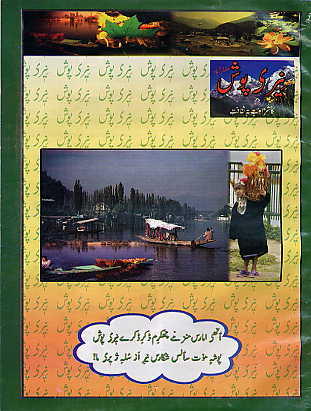 Recently I was amused to discover a Kashmiri literary magazine published from Azad Kashmir in Pakistan. The name of the magazine Neerposh is so meaningful, beautiful as well, that it reminds me of one of the earliest magazines of Kashmiri Kongposh which was published from Srinagar in 1950s. One should appreciate the significant contrast these two names reflect. I had a brief exchange of emails with Neerposh's editor Mr. Altaf Andrabi and in that conversation I learnt that there were and are a few souls who wrote in Kashmiri though mostly for Radio Azad Kashmir. This also reminds of the situation in the other part of Kashmir during 1950s and part of 1960s when Radio Srinagar was the main source of inspiration for Kashmiri writers.
Mr. Altaf Andrabi promised to send the three issue of the magazine published so far. I couldn't believe my eyes when I opened the mail; it was an incredibly beautiful magazine! One must appreciate him for his efforts and resources he has put in this magazine. I wish him success and hope that he'll be able to continue the publication, even if it's sporadic.
 In the first issue Mr. Altaf Andrabi writes, "Though this fact continues to pinch me that writing in the Kashmiri language outside of Kashmir is not only a formidable task, but also a futile practice, primarily so because of the lack of Kashmiri readers -- those who could read with interest cannot understand it; those who would understand are too busy to read; and finally those who can both understand and spare time, have no inclination towards it. But these pinches are nothing vis-a-vis the pain that I share with many ardent and compassionate Kashmiris. A pain sweet and difficult as well, always searching your heart! How can it let one alone? In order to give it a little vent, it's necessary to reach the compatriots of Kashmir in mountains, in green meadows, in scorching deserts. This journey, though long and difficult, I stronly believe, will be joined and supported by many lovers."
 One can totally understand the toughness of circumstances in which Mr. Altaf Andrabi has brought out these three issues. The magazine deserves whole-hearted support by lovers of the Kashmiri language in all lands, particularly by those in Pakistani and Indian Kashmir.
This 32-page magazine is 8.5 x 11 in size. All the three issues carry pieces by writers from both sides. Most of the pieces are overtly or covertly patriotic. I hope Mr. Altaf Andrabi broadens the gammut of contents in subsequent issues by including writings other than patriotic in nature.
Wednesday, July 13, 2005
The end of Shabkhoon
 The era of modernist Urdu writing has ended with the end of Shabkhoon's publication announced by the magazine recently. No other magazine in the subcontinent of Indo-Pak touched the standard, prestige and popularity, all three, that this magazine established under the able leadership of the legendary literary critic of our time, Shamsur Rehman Faruqi.
When I read this announcement, I had mixed feelings. On the one hand, I felt that Urdu writers lost a magazine that connected them throughtout the world in an unprecedented, unparalled way, but on the other hand, I realized that Mr. Faruqi deserved and needed this break after long, dedicated efforts of making this magazine a beacon of light for old and young writers. I believe the magazine has already achieved (with an extra mile) the goal that it had set for itself without any apparent manifesto forty years ago.
I consider this a wise decision on two counts. Firstly, it wouldn't be worth the risk of losing its hard earned image, should Mr. Faruqi have decided to let the magazine continue to be published by an editor other than himself. Secondly, I had already begun to see a caul de sac of the kind of writing Shabkhoon championed throughout its long life. In my view, Urdu writing today needs a departure, a new direction for which the closing of this magazine has, in disguise, paved the way, but, let's be frank, there's no one in the horizon who is qualified enough to take the step forward. Instead, I can see a long winter, already round the corner, that will overtake Urdu literature before it regenerates itself.
Subscribe to:
Posts (Atom)